
Inside Saint John's
By: Jack Wyman
Not everyone agreed. This is sometimes forgotten.
The risks were great. The costs were unknown. The sacrifice would be steep. The odds were long and the outcome very much in doubt.
It is understandable then that there would be a strong difference of opinion on a question so profound and sweeping. The passions ran deep.
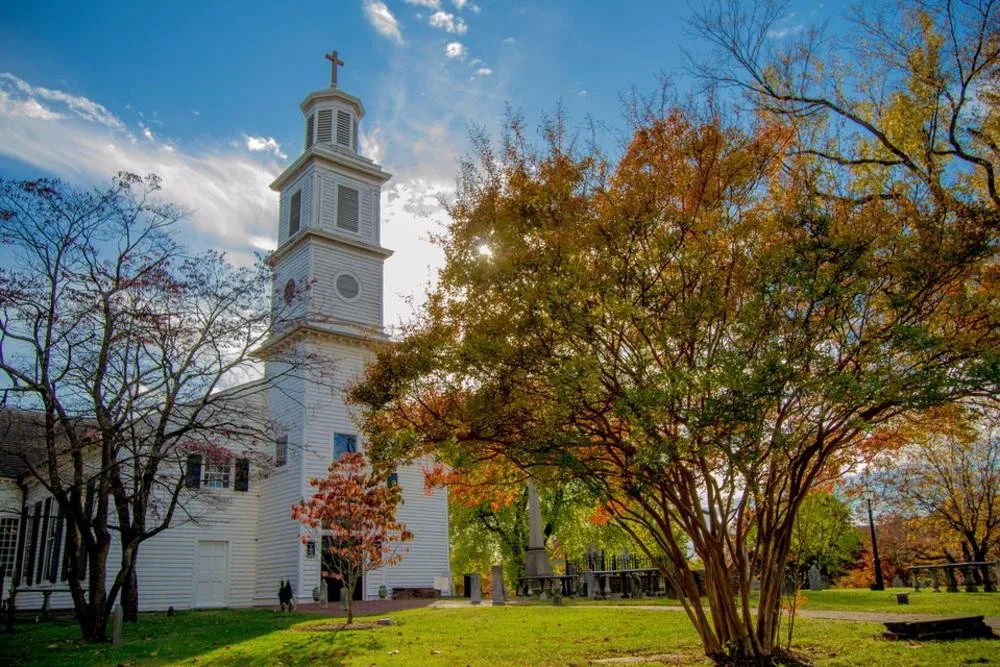
It was March 22, 1775. The debate inside Saint John’s Church in Richmond, Virginia had dragged on. Unity seemed beyond reach. The drama was punctuated by angry frustration.
The House of Burgesses was wrestling with a response to the growing crisis. The British were coming—in so many ways and in so many places. It was an inexorable encroachment: financially, politically, militarily, and morally.
The ancient writer has wisely observed that to everything there is a season. But was this spring of 1775 a time for pursuing an elusive yet peaceful resolution to seemingly irreconcilable differences? Or was this the season for war?
All eyes turned.
The tall and slender gentleman from Virginia rose to his feet. There was the look of a gaunt sadness on his fine angular features but a grim determination in his piercing eyes. He had recently buried his beloved Sarah after a prolonged illness. Throughout her suffering he had tenderly cared for her, bathed her, clothed her, and protected her from herself.
They had six children together, but this mental illness had ravaged her.
She had been denied a proper Christian burial because it was believed her sickness had been caused by a “possession of the devil.” Wracked by grief, Patrick buried Sarah thirty feet from the home they shared. Next to her grave he planted a lilac tree. It remains a testament to his devotion.
How Patrick Henry mustered his strength and resolve on this day is a marvel.
It is the greatest speech of the American Revolution, delivered by the greatest orator at a time when eloquence, quite unlike today, was a common virtue. We remember this unrivaled oration for its immortal last line. As in any great speech, however, the culmination was built upon an ascending stairway of passion and reason.
Virginia yielded more brilliant and noble founders than any other state. Washington, Jefferson, and Madison are the best known.
It was Patrick Henry, once a failed farmer and store owner who then studied the law, who on this day, and for all time, set the tone and theme of America’s unique greatness among the nations.
Oh, to have been there and heard him!
This Virginian challenged his small, fledgling, and largely rural republic to stand and fight. He threw down the gauntlet at the feet of the world’s greatest empire and defied her arrogant tyranny. He spoke with a fiery conviction about our greatest principle and our defining virtue.
Patrick Henry spoke about freedom.
In this speech, he also spoke about courage, wisdom, duty, and sacrifice. He warned his colleagues against indulging in “the illusions of hope” and in shutting “our eyes against a painful truth. . . I have but one lamp by which my feet are guided; and that is the lamp of experience. I know of no way of judging of the future but by the past.”
He challenged those who would be naively swayed by “that insidious smile” of the British monarchy even while the crown made “warlike preparations.”
“Suffer not yourselves to be betrayed with a kiss.” Henry, a devout Christian, knew his Bible.
The British had no goal but colonial “subjugation” and “submission.” There was no other choice, Henry declared. Passion stirred his heart and fueled his words. “Let us not deceive ourselves longer. . . If we wish to be free. . . we must fight! I repeat it, sir, we must fight! An appeal to arms and the God of Hosts is all that is left us.”
To those who argued that the colonies were no match against such a mighty foe, Henry counseled reliance upon God. Being “armed in the holy cause of liberty. . . we shall not fight our battles alone. There is a just God who presides over the destinies of nations. . .The battle, sir, is not to the strong alone; it is to the vigilant, the active, the brave.”
And then the conclusion—the rhetorical shot heard round the world.
He stared into the faces of the men gathered at Saint John’s Church on that early spring day in 1775. They were his friends and neighbors. He asked them now to be his comrades.
“Is life so dear, or peace so sweet, as to be purchased at the price of chains and slavery? Forbid it, Almighty God! I know not what course others may take; but as for me, give me liberty or give me death!”
Patrick Henry sat down. Silence filled the room. Several moments went by. Then slowly but unmistakably rose the mighty chorus that filled Saint John’s that glorious day:
“To arms! To arms!”
No matter the cost, no matter the sacrifice, these men would now walk together the road to freedom. In the following summer of 1776, American patriots gathered in Philadelphia. They signed the document declaring their independence from England.
“All political connection. . . is and ought to be totally dissolved. . .” They closed the document with a solemn pledge:
“And for the support of this Declaration, with a firm reliance on the protection of divine Providence, we mutually pledge to each other our Lives, our Fortunes and our sacred Honor.”
Thus, it has ever been in the land of the free and the home of the brave.
“O beautiful for heroes proved in liberating strife, who more than self their country loved, and mercy more than life!”
To order Jack Wyman’s book, “Everything Else: Stories of Life, Faith and Our World”, go to amazon.com, Christian Book Distributors or barnesandnoble.com. It is also available on Kindle and eBooks.
CHRISTIANS ENGAGED NEEDS YOU!
Would you consider partnering with us as a monthly donor to support the work of our nonprofit ministry? Or maybe a generous one-time donation?